
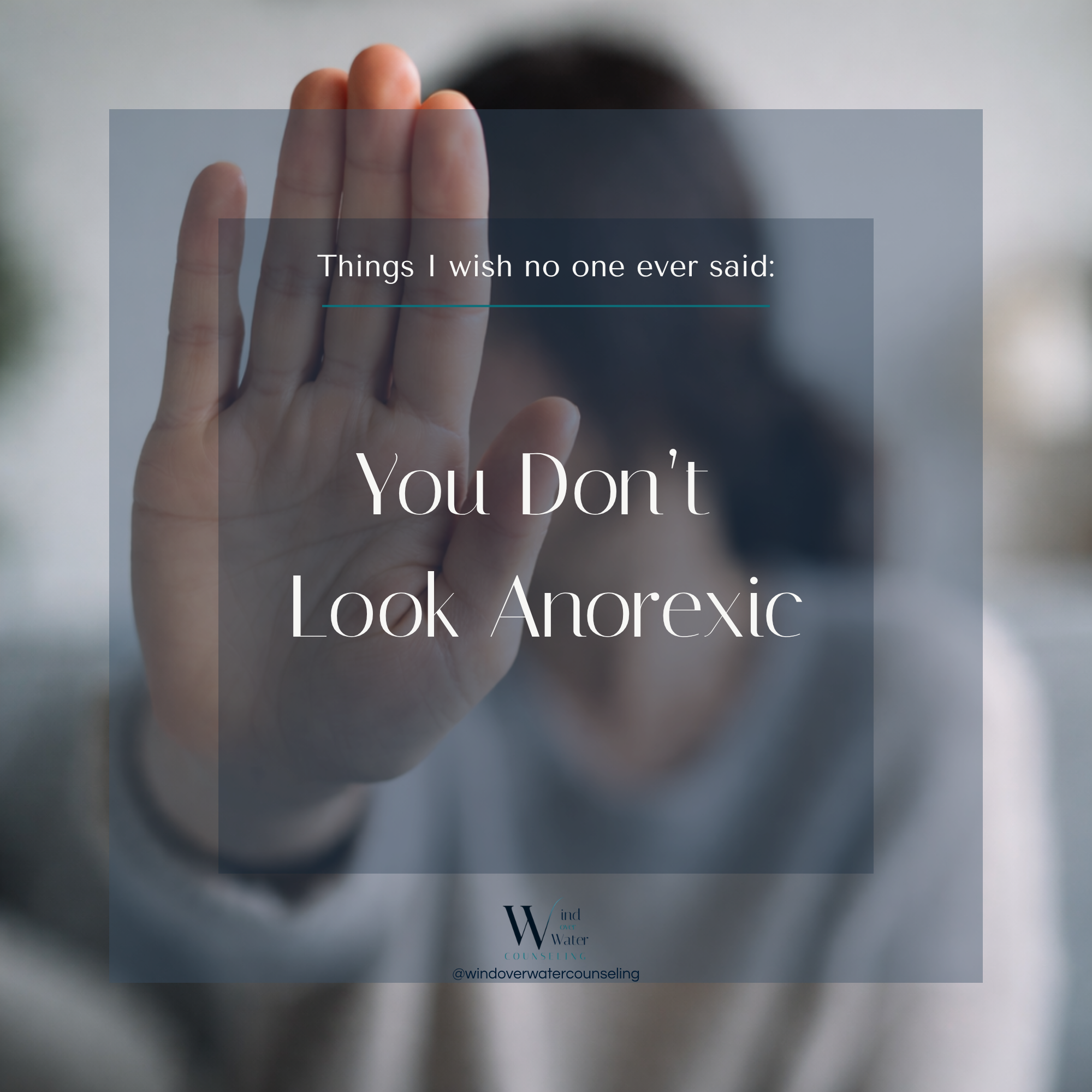
That’s the Point.

You have been thinking about food for most of the day. Not enjoying it – thinking about it; calculating it, avoiding it, bargaining with it, dreading it. You have been losing weight at a rate that would alarm anyone paying attention, through methods that have been celebrated by everyone around you. You are tired in a way that sleep does not fix. Your relationship with your body is not a relationship at all; it is a siege. And somewhere in the back of your mind, you have been wondering- quietly, because you feel you do not have the right to wonder this- whether what you are doing to yourself has a name.
It does. It is called atypical anorexia nervosa, and the only thing “atypical” about it is that your body, at the time someone looked at it and made a judgment, did not match the cultural image of what an eating disorder is supposed to look like.
That is not a flaw in your presentation. That is a flaw in the system that assessed you.
What Atypical Anorexia Actually Is
Atypical anorexia nervosa is a diagnosable condition listed in the DSM-5 under “Other Specified Feeding or Eating Disorders” (OSFED). The clinical criteria for anorexia nervosa require three things: restricted energy intake resulting in significantly low body weight; intense fear of gaining weight, or persistent behavior that interferes with weight gain; and disturbance in the way one’s weight or shape is experienced. Atypical anorexia meets all of those criteria – the fear, the distorted relationship with the body, the restriction, the psychological and medical consequences – with one modification: the person’s weight is within or above the range considered “normal.”
That is the only difference. The word “atypical” does not mean less severe, less real, or less urgent. It means the number on the scale, at the time of presentation, did not fall below a threshold. Everything else – the cognition, the behavior, the physiology, the risk – is identical.
Research bears this out. Studies, including Sawyer et al. (2016) in the International Journal of Eating Disorders have demonstrated that adolescents with atypical anorexia show equivalent degrees of dietary restriction, psychological disturbance, and medical compromise compared to those with anorexia nervosa. Dr. Jennifer Gaudiani’s book, “Sick Enough” is entirely about this issue (in its second edition, just reissued in 2025). The difference in weight status does not translate to a difference in clinical severity. The mortality risk, when you control for what is actually happening in the body rather than what the body looks like from the outside, is the same.
Electrolyte imbalances. Cardiac arrhythmias. Hormonal disruption. Bone density loss. Bradycardia. These complications do not wait for the body to reach a particular weight before they occur. They are consequences of restriction and malnutrition; and malnutrition, it turns out, is entirely possible in a body that does not look malnourished to a clinician trained primarily to diagnose it by looking.
What It Actually Looks Like in Practice
If you are reading this because you suspect this describes you, let me be direct about what atypical anorexia looks like in someone’s actual daily life, with their actual history, and their actual experience – because the clinical description above is accurate, but it is also sterile in a way that can make it easy to dismiss as “not me.”
It looks like a mental soundtrack about food that runs more or less continuously – what you ate, what you will not eat, what you should have eaten, what you are going to do about all of it. It looks like rituals around eating that feel non-negotiable, deviations from those rituals that feel catastrophic, and the sneaking suspicion that you have organized your entire life around the avoidance of something that most people do three times a day without incident.
It looks like a compulsive relationship with exercise – not the kind people celebrate on Instagram (well, sometimes they do, but we should unfollow those people), but the kind where rest feels dangerous, and a missed workout feels like a moral failure. It looks like energy you do not have, concentration you cannot sustain, and an escalating irritability that everyone around you is noticing even if you are not.
It also looks like a person who has been told by their doctor that they are “making progress.” Who has been told by everyone who loves them that they look amazing. Who has been handed a gold star by a culture that monetizes restriction and calls it wellness, and who has been made to feel, in every possible direction, that what they are doing to themselves is not only acceptable but admirable.
Diet culture does not identify eating disorders in people in larger bodies. It gives them gold stars. That is not incidental; it is the mechanism.
Why You Were Not Diagnosed Sooner – and Why That Is Not Your Fault
The medical system has a weight problem. I do not mean the one it keeps insisting you have.
Weight stigma in healthcare is extensively documented. Research by Puhl and Heuer (2009) and subsequent literature demonstrates consistently that clinicians – including mental health clinicians – underestimate the severity of eating disorder symptoms in patients presenting in larger bodies, are less likely to initiate eating disorder assessments with those patients, and are more likely to treat weight loss as an unambiguously positive outcome regardless of the method or the cost. This is not a character indictment of individual providers. It is a systemic problem rooted in a cultural framework so thoroughly conflated with medicine that even well-trained clinicians absorb it without realizing they have.
I want to give some grace to the clinician who missed it; the miss is rarely malicious. It is structural. The training programs, the assessment instruments, the cultural narratives that providers have been swimming in since before they ever saw their first patient – all of them were designed with a thinner patient in mind. The picture of anorexia that lives in the clinical imagination is a picture that has always excluded a significant portion of the people who have it.
What I will not give grace to is the system that produced and perpetuated that training. The system that continues to use weight as the primary indicator of eating disorder severity, that sends people home reassured when the reassurance is wrong, that has consistently prioritized the legibility of a diagnosis over the well-being of the person carrying it.
You were not missed because you did not present clearly enough. You were not missed because your symptoms were ambiguous or your distress was insufficiently dramatic. You were missed because the system was not built to find you – and it has had decades to fix that, and has largely declined to.
That is the system’s failure. It belongs to the system.
What Treatment Looks Like, and That It Exists
Treatment for atypical anorexia is treatment for anorexia nervosa, because that is what it is. This means several things that are worth stating plainly, because they contradict what a lot of people have been told.
The goal of treatment is not weight loss. It is not weight maintenance. It is not any weight outcome. The goal of treatment is nutritional rehabilitation, psychological stabilization, and the development of a sustainable, non-disordered relationship with food, the body, and the self. A treatment provider who recommends continued restriction, caloric targets below maintenance, or the pursuit of weight loss as part of your recovery plan is not practicing eating disorder treatment; they are practicing diet culture with a clinical letterhead. You are allowed to say so.
Evidence-based treatment approaches include Dialectical Behavior Therapy (DBT), which addresses the emotion dysregulation underlying disordered eating behaviors; Enhanced Cognitive Behavioral Therapy (CBT-E), which targets the specific cognitions maintaining the disorder; and Family-Based Treatment (FBT) for adolescent presentations. Depending on medical stability and psychological acuity, higher levels of care – intensive outpatient (IOP), partial hospitalization (PHP), or residential – may be clinically indicated, and that recommendation should be based on what is actually happening in the body, not on what the body looks like.
The provider credential to look for is CEDS – Certified Eating Disorder Specialist – issued through IAEDP (the International Association of Eating Disorders Professionals). A CEDS has completed specific training and supervision in eating disorder treatment across the diagnostic spectrum; this is not a credential generalist therapists hold, and it matters. A CEDS-C is a Certified Eating Disorder Specialist-Consultant – which means they are also trained to supervise and consult with other providers working in this area. The credential exists specifically because eating disorder treatment requires specialization, and specialization requires accountability.
You deserve a provider who has done this work. Not someone trying their best with a population they have not been trained in. Someone who has seen this before and knows what they are looking at.
If a Clinician Has Dismissed You
You are allowed to walk into a clinical encounter with information. You are allowed to say: “I have been reading about atypical anorexia nervosa, which is listed in the DSM-5 under OSFED. I meet criteria B and C for anorexia nervosa, and I have lost [X amount of weight] through restriction over [time period]. I would like a formal eating disorder assessment.”
You are allowed to ask for a referral to an eating disorder specialist. You are allowed to seek a second opinion. You are allowed to bring your own documentation – your history, your patterns, your account of what has been happening – and require that it be taken seriously. A clinician’s assessment is not the final word on your experience. You are the expert on your own interior life; the clinician is trained to assess and diagnose, not to override what you already know.
If the clinician responds to your direct request with a recommendation to continue what you have been doing, that is information. You are allowed to find a different clinician.
The Bottom Line
Atypical anorexia nervosa is anorexia nervosa in every clinically meaningful sense, presenting in a body that does not match the cultural image of what an eating disorder looks like. It is underdiagnosed, undertreated, and largely absent from the general-audience writing on eating disorders – not because it is uncommon, but because the system was not designed to find it, and the culture actively rewards its symptoms. The psychology is identical, the medical risk is identical, the treatment is identical. The only thing that differs is the number on a scale; and that number has been doing more gatekeeping than any diagnostic system intended or should permit.
If you recognized yourself in this piece: the diagnosis is real, the treatment is real, and the clinicians who missed it were working from a flawed framework. That is the system’s problem to fix. In the meantime, you are allowed to name what you are experiencing, to insist on assessment, and to access care that is actually designed for the disorder you have.
“This is as good as it gets” is a lie. It is a particularly convincing lie when the system reinforces it with a clean bill of health. But it is still a lie.
Resources
- DSM-5 OSFED criteria (Atypical Anorexia Nervosa): American Psychiatric Association – psychiatry.org
- NEDA (National Eating Disorders Association): Information and treatment finder – nationaleatingdisorders.org
- National Alliance for Eating Disorders – helpline and free support groups – allianceforeatingdisorders.com, 1-866-662-1235
- ANAD (National Association of Anorexia Nervosa and Associated Disorders): Peer support and resources – anad.org
- EDReferral: Find eating disorder specialists by location and credentials – edreferral.com
- IAEDP (CEDS credentialing and provider directory): Verify provider credentials – iaedp.com
- Puhl, R.M. & Heuer, C.A. (2009). “The Stigma of Obesity: A Review and Update.” Obesity, 17(5), 941-964.
- Sawyer, S.M., Whitelaw, M., Le Grange, D., Yeo, M., & Hughes, E.K. (2016). “Physical and Psychological Morbidity in Adolescents with Atypical Anorexia Nervosa.” Pediatrics, 137(4).
- Strings, S. (2019). Fearing the Black Body: The Racial Origins of Fat Phobia. New York University Press.
- Reclaiming Health When Wellness Fixates on Weight
- Eating Disorder Awareness Week 2026
- The Push/Pull of Therapy – Navigating the Gray Areas of Diet Culture & Change
- Wind Over Water Counseling: Eating disorder and trauma treatment in MD, NC, VA via telehealth. CEDS-C supervised practice. www.windoverwater.net