


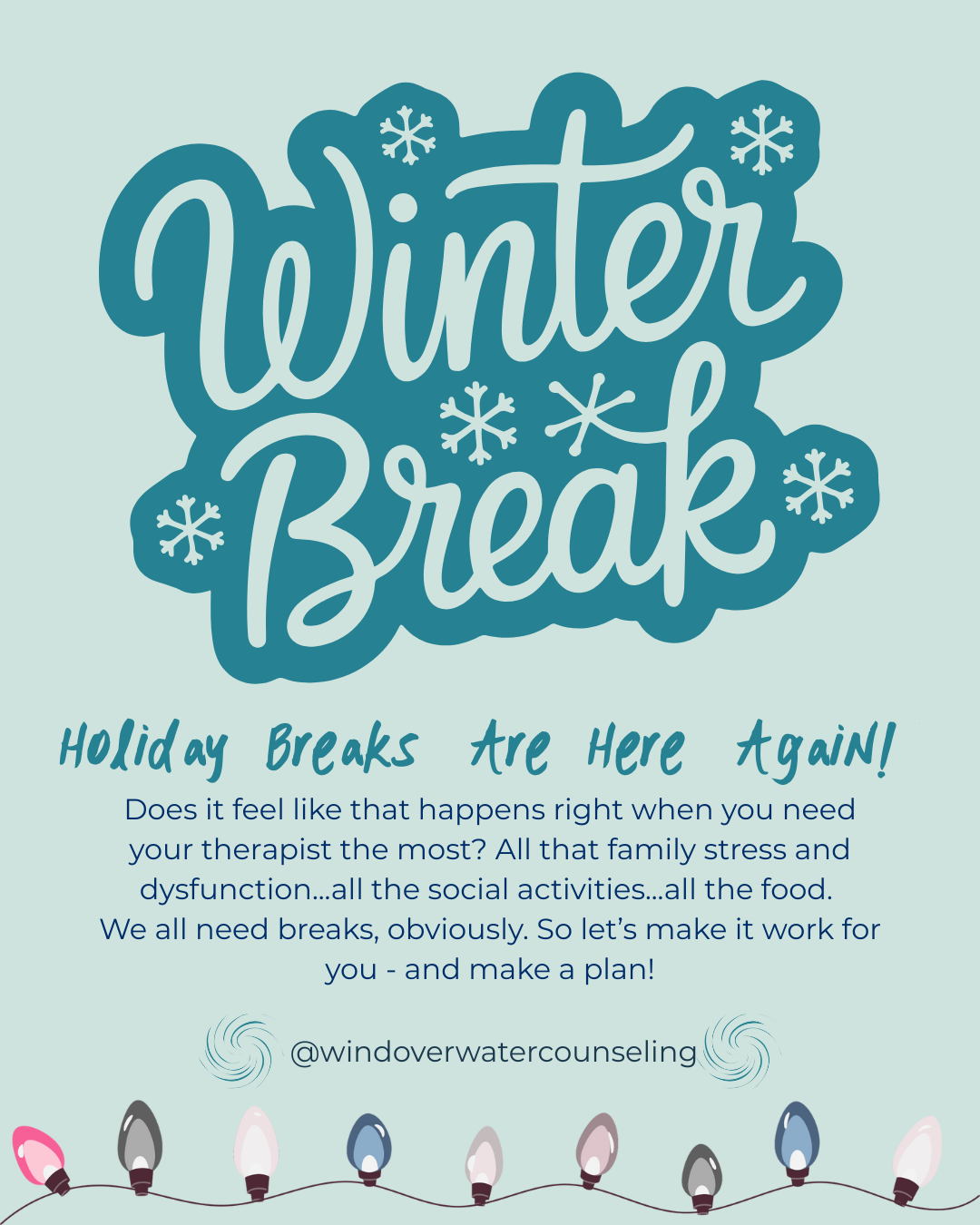
When You Need Therapy The Most?
Therapy breaks arrive right on schedule and never when you feel prepared. Providers take time off around the holidays. Life gets busy, clients travel, schedules clash, crises appear, and suddenly you look at your calendar and realize you will not sit on the couch and decompress with your therapist for two or three weeks. The gap feels like a cliff edge. You start imagining your coping skills leaking out of your ears. You worry you will lose progress. You assume you will snap back to old patterns the second the calendar flips.
I hear this fear every year around this time. I also see how much shame people carry when they react strongly to a therapy pause. If you have trauma or an eating disorder, rupture and unpredictability live in your nervous system. Breaks hit the same alarm bell, even when the therapist is not disappearing, even when the relationship stays intact. You feel abandoned even when you know you are not abandoned. Your brain has a long memory and very little patience for nuance during December.
This post is not here to coddle the belief that a therapy break means failure or fragility. It exists to challenge the internal narrator that insists you should cope perfectly without support. That voice comes from trauma, culture, and the fantasy that healing should resemble a productivity chart. You do not need to perform wellness. You need a container for the chaos and a strategy that keeps your nervous system steady enough to get through the weeks without collapsing into old survival patterns.
Diet Culture, Productivity Culture, and the Therapy Break Spiral
Every winter I watch the same thing happen. People start comparing themselves to some imaginary person who uses December to optimize. They imagine the woman who journals at dawn, does yoga in candlelight, organizes her pantry, and emerges in January as a glowing phoenix with labeled bins. Diet culture loves this season. Productivity culture thrives on it. Together they whisper that you should use your therapy break to reinvent yourself. As if trauma takes PTO. As if eating disorder recovery strengthens because you grit your teeth harder.
This nonsense creates shame. Shame fuels dysregulation. Dysregulation fuels the belief that you must be broken because therapy is not available this week.
I prefer a different interpretation. Therapy breaks reveal the truth about your resilience. Not the glossy performative kind. The grounded, flexible, imperfect resilience that looks more like staying hydrated, texting one safe person, or not skipping meals when the emotional weather turns rough.
Resilience lives in compassion, integrity, resilience, candor, acceptance. These do not require weekly sessions to exist. They live in your body and your habits. Therapy sessions help you access them. Breaks let you practice them.


Relational Anxiety During Breaks
If you have a trauma history, your system monitors relationships like a security guard with binoculars. A therapy break triggers the part of you that learned people can vanish without warning. Even a predictable holiday schedule can feel like a rupture. Your logical mind understands your therapist is visiting family or taking a rest week. Your body experiences the absence as threat.
Many clients tell me they feel embarrassed to express anxiety about the break. They apologize for needing support. I push back on that. You learned vigilance because you needed it. You learned hyper awareness of distance because distance once meant danger. You do not erase those patterns through willpower. You shift them through relational consistency. Consistency includes repair. And yes, consistency also includes planned pauses.
Therapy breaks expose attachment wounds while offering a low stakes place to practice trust. Trust that the relationship continues despite the gap. Trust that you can hold yourself without collapsing. Trust that the work lives in you and not only in the hour you pay for. This is not a spiritual test. It is nervous system retraining.
Containment Practices That Actually Work
Containment does not mean suppressing emotion or locking your trauma in a mental storage unit. Containment means building a temporary holding space strong enough to keep your distress from spilling everywhere while you wait for regulated support. Think architecture rather than avoidance. Think boundaries rather than perfection.
A simple sensory container helps more than people expect. Your system needs predictable physical anchors when emotional cues feel unstable. Here are practices I often recommend this time of year.
Sensory Grounding
Place both feet on the floor. Describe silently what the floor feels like. The texture, temperature, and pressure. Your brain returns to the present when your senses give it something real. Cold objects help. Hold an ice cube for a few seconds. Touch a stone. Run your hands under warm water. Use whatever sensory cue softens the internal noise. (See the TIPP skill).


I encourage clients to create a sensory soothing kit, otherwise known as a Calm Down Kit for Grown Ups. A scarf with a texture you like. A lotion with a scent that calms your system rather than overwhelms it. A smooth object that fits in your hand. Think of intentionality without the aesthetic pressure. This is about function, not decor. Your body responds to repeated sensory cues, so keep the items consistent.
Distress Tolerance for the Holiday Season
Distress tolerance gets mislabeled as pushing through. In reality, it looks like allowing discomfort to exist without letting it dominate the room. The weeks without therapy offer practice. When anxiety swells, your system needs structured activity that interrupts the spiral.
I often suggest a paced routine that includes movement that does not glorify calorie burn. Walk your dogs. Stretch slowly. Shake out your hands. Stand up and change your posture when rumination ramps up. Eating disorder recovery benefits from predictable rhythms. Trauma work benefits from gentle bilateral stimulation. Combine both and you get a surprisingly effective anchor.
Cold water splashes, square breathing, or a weighted blanket shift your physiological state. The point is not to eliminate distress. The point is to lower the volume so you regain access to choice.
Voice Memo Strategies
Many clients assume journaling must be poetic or wise. I disagree. Journaling works best when it resembles a brain dump. If writing feels tedious, use voice memos. Speak openly and quickly. Say what scares you about the break. Say what helps you stay grounded. Say the thing you would tell me in session. Your brain processes emotion through language and tone. You gain regulation from hearing your own voice hold your truth.
Store these memos, emails, notes – whatever way helps you express yourself. Access them later. Not in a self critique way. In a “Wow, look how well I navigated that” way. It becomes a relational tether to yourself when your therapist is not available.
Boundary Reinforcement
Therapy breaks tend to collide with holiday chaos. This means family dynamics appear in full force. People test your limits. Food becomes a minefield. Productivity myths scream that you must bake, wrap, host, clean, and sparkle. Your job during a therapy break is to protect your nervous system ruthlessly.
Eat consistently. This is not optional. Recovery requires feeding yourself even when anxiety blares. Reduce contact with people who drain you. Step outside when tension spikes. Say no early rather than apologizing later. These boundaries are not personality flaws. They are survival tools.
The Myth of Losing Progress
Progress does not evaporate because you miss two or three weeks of therapy. Progress never lived in the appointment slot. It lives in your practice. Therapy breaks reveal your integration. They force you to examine how you hold yourself between sessions. Think of the break as a diagnostic window. Not a character indictment.
Clients often tell me they fear regressing. I ask the same question every time. What does regression mean? Usually it translates to “I feel overwhelmed again and I interpret that as failure.” That belief aligns perfectly with diet culture and productivity culture. Both promote the fantasy that linear improvement proves worth. Trauma recovery never works that way. Neither does eating disorder work. Life does not work that way, for anyone. You move forward, pause, step sideways, rest, grieve, repair, and continue.
If you feel shaky during a break, that does not mean you lost ground. It means you hit a stressor without your usual scaffolding and your system reacted. This is expected. Normalize it. Debunk the shame. Use the tools you have practiced. That is progress.
The Role of Candor and Acceptance
Healing requires candor. You cannot navigate therapy breaks with denial. Admit when you feel anxious about the pause. Admit when you miss the structure. Admit when you feel angry that your therapist gets time off while you still manage your symptoms. Anger often hides fear. Bring the anger into the light rather than feeding it in secrecy.
Acceptance does not mean approving the break or pretending it feels great. Acceptance means recognizing reality without amplifying suffering. You do not control your therapist’s schedule. You do control how you respond to the gap. You can resist the shame narrative. You can reject diet culture’s pressure to use the break for reinvention. You can choose compassion over perfectionism.
Staying Grounded in the Absence
You stay grounded by practicing your tools, supporting your body, and remembering that therapy is not a fragile connection. The work continues even when the calendar pauses. You feel discomfort because you care about the relationship and because your nervous system remembers how abandonment felt. That vulnerability does not make you weak. It makes you human and healing.
I tell clients this all the time. “You can handle more than your mind wants to believe. You already hold resilience.” It’s about how you talk to yourself, how you feed yourself, how you move your body, how you speak your truth, and how you respond to imperfection. Therapy breaks do not remove your capacity. They reveal it. That’s why we step back gradually when you feel you’re ready, so you have more time to practice without removing the safety net.
Stay hydrated. Eat consistently. Use sensory grounding. Talk out loud to yourself with honesty and humor. Politely decline the productivity cult’s invitation to ascend. You are not here to transform into a new year archetype. You are here to stay connected to yourself even when the world feels loud.
Healing does not pause. Neither do you.
Resources & Links
- I Am Not That Therapist
- Self-Care for Humans, Not Algorithms – December 2024
- The Push/Pull of Therapy – Navigating the Gray Areas of Diet Culture & Change – December 2024
- Revolutionize Your Holiday With Rest – December 2024
- How to Manage Breaks From Therapy